It's the end of the world. The Governor's come to stage a reverse-prison break and died for his efforts. Our team has been splintered into some of the most unlikely pairings as they search for one another, hoping against the worst. Beth--the good, little girl--and Daryl--the bad, good ol' boy--find a shitty, backwoods moonshine joint, just like Daryl grew up in. They get drunk, they share stories, they bond, and at Beth's suggestion they burn it down, with a stack of useless money and moonshine. And as they watch it burn, at Beth's insistence, the good girl and the bad man give the finger to the past. It is the sweetest most moving employment of the bird that I've ever seen. The Mountain Goats play Up the Wolves in the background.
Showing posts with label comics. Show all posts
05 May 2015
On Watching "The Walking Dead" III
Labels:
Art,
comics,
music,
psychoanalysis,
The Walking Dead
16 April 2015
On Watching "The Walking Dead" II
| This image is a metaphor for the show. As such. The dream-like nature of the moment did not prevent me from weeping. |
They measure you by what they can take from you. By how they can use you to live.
Meanwhile, back at the end of the world in Georgia, a metaphor is being deployed. And that metaphor is explicating the conflict between, what I would call, Love and right-wing Conservative politics and policies and policing.
On the one hand, we have Our Team that we're rooting for, going through it. Like REALLY going through it. Struggling to find ways to maintain community, friendship, family--and therefore Love--and not turn into the others: not the undead, mindless destroyers, but the living ones, who give up on everything that marks civilization, as such--in a bid, not just to survive, but to dominate--secure in the belief that domination and survival are only coextensive and/or co-Terminus, instead of considering the possibility of them being coterminous.
Rick and Carol's incredibly even, often dead-seeming stare not to the contrary--a stare that, in contrast to most of their actions, only marks the success of their struggle to stay human--our team offers a very textured, layered series of responses regarding one's self-identity and one's self-delusion (often the same thing), one's ability to create meaning, one's love for one's sister or brother, whether one is one's sister's keeper, and whether one is responsible for civilization, or not. I hold that we are responsible for all these things. And I hold to this response-ability, not out of some misplaced nostalgia for a better time in the past, but out of a misplaced interest, desire, and demand for the future. In fact, I require it. I require it of me and I require it of you.
One's ability to create meaning is core to this metaphor, not as the problem of not creating meaning--a problem we don't have--but out of the necessity and the endless human imperative to do so. We cannot not create meaning. What separates us from the animals and insects--from what we presume to call "Nature"--is meaning-production, in all of its ambiguities, vagaries, and lies. This is the essence of language.
The issue is not that other animals don't have symbol-systems or feelings--of course, they do--it is just that our symbol-system is shot through with a kind of ambiguity and play that I believe is unknown to our animal friends. Cats are the Japanese of animals; Americans are the dogs; yet, for all the richness of the animal symbol-systems, they pale before ours. It's not their fault. The Axial Age marked a simultaneous and gigantic leap "forward" from them, and we don't know why--no, we don't; not exactly; not really--nor whereto and to what end, though some of the more depressing indicators are clear.
Certainly, animals have their tools, and their feelings, and their language. Notice their industrial revolution. Marvel at their gridlocked, ideology-consumed, plutocrat-run political systems. Look at their nation-states and their wars, their weapons of mass destruction, their hedge markets and stock exchanges; their banks, pharmaceutical companies; their mustard gas and guns and hydrogen ordnance; their drug addictions and world-wide religious affiliations; look at their laws; look at their writing, their theater and symphonic works and dance vocabulary; their poetry and trash fiction; look at their Jim Crow laws and concentration camps; look at their schools; their utopian claims and their dystopic interventions; look at their lawyers, prostitutes, drug dealers, accountants, lobbyists, and markets; behold their polemics and rhetorics, logics and philosophies; their intense and subtle disagreements about these things; witness their drive for nothing but money; witness their money, their lotteries and casinos, their mafia; their shamans, soothsayers, clergy, and holy men; witness their mystics; and grow to appreciate their full-scale dismissal of climate change, which affects them least of all since they live outside: they have no inside, no insulation, no thermostat, and no aeroplane to take them on vacation; they have no vacation; they have no work, no movies, no television, and no internet. They are fundamentally not like us. So, please, stop boring me with your comparisons to the animals and insects; please stop telling me how much we're alike, because we are not. Your statements are only metaphors as justifications for your behavior--and The Walking Dead is shot through with these comparisons from suitably unsuitable characters--yet I've never seen any "natural" thing do what you do. No; we're stuck with each other, you and I, in this world not created by animals, but modified by animals with an awareness of ambiguity but an unshakable need for certainty, most especially when that certainty is the most deadly thing on the planet.
The Axial provides evidence for humans employing a new facility for tool-use, including language, which is, after all, also a tool, but hardly only a tool--it is a tool like no other: it is an environment: it is the substance and structure of thought itself: we swim in it and it swims in us. One assumes, in comparison to the animals, that the Axial allowed us to leave the pseudo-psychosis of one-to-one correlations and certainty behind, and embrace the inherent ambiguity of large symbol systems, which are not and never have been set and clear, except to the psychotic among us. I say this is no way to impugn the truly psychotic, who rarely participate in the genocidal-level, sociopathic, blood sport that I will attribute to what I am choosing to call the waking dead. And this is what this post is about.
I began this post saying that The Walking Dead details the various choices of Our Team, the dwindling and growing, waxing and waning, group of survivors clustered around Rick Grimes, who by season five, with his beard, has started to look like a hot cross between Jesus and God. There are other choices being detailed as well, in this employment of metaphor, and these, for the most part, do not involve Love. What we witness instead is the spectacle of humans going feral: humans in the wild, not just without civilization to keep them in check, but a demonstrable rejection of civilization. We are speaking of a different kind of discontent. Rather it is a new kind of contentment with savagery, with murder, cannibalism, and pleasure in these things. It is Schadenfreude articulated at the level of an ethos.
Over and over Our Team either comes across people or is come across by people who have made horrible choices--and Our Team has made HORRIBLE choices, too--but these others, the waking dead, only have it in for anyone else who crosses their path, in an Us Against Them, that must always and only end badly, must always end in Evil. Our Team actively resists this conclusion--and it is a conclusion, in every sense of the term--and we, as audience members, yell at the screen, "Kill them!" but they very rarely do. To us, the paranoia of the Zombie Apocalypse puts us more into the camp of the waking dead than Our Team. Their struggle with this question is the problem and the point.
Despite the blood and gore, which has become more intense, even personal, as the series progresses, despite the first two seasons during which the series explored what to do about the zombies--realizing that the zombies are not the text, are only occasionally the subtext of the show, but are the backdrop--the show is about the living, the living who choose to be dead, and the living who choose to not just not be the dead, but who choose to be the living. And for humans, choosing to be the living means always thinking, remembering to feel, and to build bonds based on Love not Death.
Now, the all or nothing, Us Against Them, every-man-for-himself, how-can-your-life-benefit-mine continuation of the destruction of the world of the others, of the waking dead--the very thing that Our Team exists as a site of resistance against, even with all their mistakes--is right-wing, Conservative politics, policies, and policing as we experience it today. It is the coldest, most frightening, death-loving machine the human race has yet produced. It produces the end of civilization and the end of the world without even seeming to believe in either of those things, which is terrifying. And the dreams which are narratives on our television screens and in our comic books--even more remarkable for having been produced by corporations, the great engines of our destruction and political destitution--offer both a critique and an alternative. Must we get to the place on display in The Walking Dead before can realize alternatives are possible?
Labels:
Art,
comics,
History,
love,
movies,
the Economy,
The Walking Dead
12 March 2015
On Watching "The Walking Dead"
A few years ago, my ex used to be annoyed at how the culture--its films, television, and narratives--had become overrun with vampires and zombies. I don't know what he thinks about it now, because I haven't asked him, but it seems clear that the futile fantasy of beauty, glamour, boredom, and power that is the undead vampire is on the wane (reality television, among other things) and zombies, the mindlessly persistent idea of us, as dead, as relentless consumers of everything, is ascendant--that and the sense of outlaw survivalism against the worst odds that we see in Sons of Anarchy, The Hunger Games, and Divergent, and, of course, The Walking Dead.
Our books, our comic books, our movies, and our television shows are our dreams, as a culture. Read them awake. Awaken.
Labels:
comics,
History,
Politics,
psychoanalysis,
the Economy,
The Walking Dead
15 February 2007
The Trouble with Smallville
Matthew Shepard by way of Pierre et Gilles? What will they think up next?
I am not a Smallville enthusiast, I am a Smallville stalker. It’s a shitty show, so I hang back in the sidelines, TiVO episodes, close my eyes or fastforward through the dull scenes (of which there are many), and try to catch a glimpse of what really gets me off.
It’s a shitty show, as I said. I was never offended by the Matthew Shepard ad campaign when the series first went on the air because those ads were erotic and squared neatly with the (possibility, anyway) of a queer take on the oppressed outsider. Let me explain (while I abhor the personal, this is relevant): when I was a kid, I always thought the hottest part of any Superman story was when he was rendered helpless by Kryptonite. The idea of this nigh omnipotent god rendered weak and defenseless held a clear sexual thrill for me (does this make me kinky? I sure hope so). Part of the story is that Superman always eventually triumphed—while he may momentarily be the plaything of whatever sadist of the moment had chained him, he always escaped and won in the end. Compare this with the original Superman movie when Luthor puts the Kryptonite soap-on-a-metal-rope on Superman, yet Miss Teschmacher kisses him and frees him. Hot. “Why is it I can never get it on with the good guys”? Honey, you just did.
Anyway, Smallville. The problem I have with this show is that when it’s good, it’s really good, and when it’s bad, it’s just plain, stultifyingly awful. I mean, a viewer suffers, and I mean that very literally, through many, many episodes of crap before hitting one that has decent writing and actually offers a payoff.
The most recent episode (tonight) explains what I mean: In the past couple years, the show has slowly—very slowly—become (slowly) populated by other known DC Comics characters: Kid Flash (Beaver on the far superior Veronica Mars), Aquaman (or should I say “boy”—a lovely specimen who couldn’t act his way out of a goldfish-containing-ziplock), a young Green Arrow (more or less [what does that mean?] the opposite number to Lex Luthor’s rich-boy-using-his-money-for-kicks act), and Cyborg (? again a question mark?) of the Teen Titans. When all these heroes team up, it’s a mini-Justice League, and a lesson to Clark that he doesn’t have to work alone (shades of “Buffy”). My friend, Josh, who is the only person ever to have his real name revealed on this blog, called this episode “Superhero Porn.” And so it was, Gentle Reader. But even this is not what this post is about.
No. This post is about a crappy show that occasionally rises above its sub-par status quo to really say something, or to finally show off its actors as being more than automatons. In this case we have both.
Kristin Kreuk may or may not be a capable actress—I will fault the material in her favor. For now. But she so often goes to the same three, or four (to be generous), places that she has become my most hated performer on the show. Finishing just behind her is Michael Rosenbaum as Lex Luthor. I can’t tell if it’s an actorly choice or not, but every word that comes out of this motherfucker is a lie. You watch him lie on every episode—and it's totally unconvincing. This is either brilliant technique or stupid blundering, and the only—and I mean only—example of how Rosenbaum (who has clearly been shaving his head since 2001, which is similar to but not identical with James Marsters’ commitment to Spike on "Buffy") is making choices is last year’s Christmas episode a la It’s A Wonderful Life wherein the actor exhibited humor, charm, warmth, confusion, and irony. These are things he should exhibit, but never does, on a regular episode.
You see this is why I blame the show, and by that I mean the creators and writers, for making it so dreadfully dull. In someone like Rosenbaum, we occasionally, and by that I mean rarely (and by that I mean almost never), see the actual talent of the actor. And on this note I have to say that the greatest casualty, or rather the greatest success, is Annette O’Toole as Martha Kent, who spins dramatic shit into gold every week. Somehow, this woman finds a way to make sense out of every idiotic narratival maneuver and she does this effortlessly. I always wait to see Martha Kent on Smallville, because when it is bad, she’s the only good thing coming—and she’s really good. This is the test of an actor. She can turn what would be a “Your father’s right” on the Brady Bunch moment into a real dramatic event. Annette O’Toole rooles. Alas, though she was absent tonight, the episode stood on its own.
But let us return to the Trouble with Smallville. This is the problem: the writers write the same shit for nineteen episodes a year, but they reserve the right to write three episodes where something really happens. Tonight was one of those episodes. And Kristin Kreuk (Lana Lang) perked up and became more than a little interesting. The writers have been pushing her character a bit recently, and tonight she was fairly real as she tried to reconcile her suspicions about Clark and his strange ability to be always at the right place at the right time with Lex’s (her fiancé and father of her unborn child) ability to always be at the wrong place at the wrong time. As I said, I hate Kreuk as Lana. It may not be her fault and we can look to the writing for that, but Lana Lang became an interesting, truly conflicted character for me for the first time tonight. And now a brief excursion about lying.
Smallville is based entirely upon the question of lying and being an ethical person. What this means as a viewer is that this theme is present endlessly throughout the show, but in three episodes a season it receives a fair appraisal. Clark is, and has always been in love with Lana, and their relationship has constantly (and quite consistently, which is to say boringly) foundered upon his mysterious absences during miraculously averted crises. When they were together, the narrative thrust depended on him saving the day without her finding out and also her knowledge that something was “up.” This became (occasionally) an interesting meditation on the merits of the Lie and why good people might tell them. Clark dreamed of marrying Lana, but through all the (many, many) permutations of him trying to keep her safe by protecting his secret, he ruined the relationship and she turned to Lex Luthor for comfort, love, certainty, and became pregnant by him.
Now, we all watch as she discovers that Clark isn’t who he seems to be and that Lex isn’t either. The closer she gets to understanding that Clark Kent is “different,” the more she wants to protect him. This is good television! You have to understand this in the context of season after season of Lana knowing "something" and Clark denying it. We’re at an interesting juncture in this show where Lana, logically, should learn Clark’s secret, but where the writers will let us down by keeping it from her. Part of this is the continuity of the DC comics universe where Lana must be kept in the dark so that Lois can move into the frame, but it is strikingly unsatisfying. For this reason the series will always get it wrong when it is closet to getting it right. The love affair must always never actualize; Clark will never tell Lana the truth; and as interesting as she becomes, and as hard as Kreuk works, Lana will always end up on the trash heap of comics history, because this story was written before it ever aired.
This is too bad, by the way, because the best episode of last year was about Lana finding out how super Clark is, and forgetting (shades of Superman II) and Pa Kent (the delicious John Schneider, oh daddy!) dying--but the viewer needs some sort of satisfaction. Endless denial is not really the coin to barter. After six years, it just becomes a big-ass drag. Even when it’s really good.
27 June 2006
Superman. The Movie.
Origin Stories
It's funny. My re-interest in comics is almost neatly coinciding with the revival of the Superman movies (or we hope movies if Singer does a good job), which were the source of my first fascination with comics. As I've mentioned before in this silly online whatsis called a "'blog," Superman, The Movie, and by that I mean the Richard Donner/Christopher Reeve/Margot Kidder/Gene Hackman/Mario Puzo et al. film of 1978, was a fairly powerful factor in my childhood. I am clearly not alone among gay men (and others) in this. Blogs are a-buzzin' with anticipation for Bryan Singer's Superman Returns--opening at the end of the month (and by the time I post this, has already opened)--and most of the excitement I've been reading has been fueled by a strong fondness if not downright love for the first two movies. I am such a painful geek about this stuff that when I saw the first preview for Superman Returns--a loving tribute to the initial cloud, sun, and sky trailer for the first Superman, complete with what sounded like a Brando voiceover, and snippets from the original, John Williams score--I actually got teary. And I'm not so easily moved. But it struck a chord for me, a very old one in an old place that hadn't been touched in a very long time, and that is sort of the reason I'm writing this little tribute to Superman and to some extent Superman II.
Superman, The Movie was the first film I saw multiple times--when it was on HBO at a friend's house, I made a point of making an excuse to go over and watch it. I remember leaving the theater after seeing this movie--and this was also a first--with a wonderful feeling of happiness and satisfaction. It was a kind of buzz that I went back for more than once, and thankfully, the film was re-released at least one or two times in those years before video. Studios used to do that sort of thing back then. It's how I saw Jason and the Argonauts (1963)--that deliciously empty but beautifully stop-motion animated Ray Harryhausen treat of a film--on the big screen after many viewings on television. I sometimes wonder how impoverished, in a way, the children of today are, paradoxically, by the explosion of media and TV channels. I grew up with ABC, CBS, NBC, PBS, and a couple local channels in
There is a quality of sweetness about our childish obsessions, because, and not despite, the fact they were tinged with a green eroticism. There is no doubt whatever that part of the appeal of Superman for me was Chris Reeve, his muscles (especially because he was a skinny, but tall, shrimp of a man before he worked his ass off to get big for the role), his clumsiness and shyness, the sweet holding back he showed with Lois, his manliness, his politeness, his selflessness, and his vulnerability. There is no doubt that as with other hero figures in any boy's life, there was the unintelligible, ineffable difference between wanting to be him and being in love with him. For gay boys, a similar thing happens with the confusion about powerful women: Am I in love with Ann-Margret or do I want to be her?
Curious, isn't it, that gay men seem to be attracted to power of one kind or another: physical, sexual (as we've seen in some cases, but hopefully not often, political power). Yet for me, the appeal of Reeve's Superman was also the vulnerability, the sadness, the withholding, and of course, as has been written on extensively, the double identity. It is a double identity that one yearns to reveal--as Superman yearns to, and eventually does, reveal to Lois--to the people one is attracted to, or to one's parents, or to the world. But the specialness of that secret, its secretness, is always sexualized as the it grows closer to its revelation. It is a tease in the movie--and a self-tease in life, as you struggle to not tell your high school best buddy that you love him, of which it reminds, whether you know it consciously or not--when Clark starts to tell the dazed Lois, just after her interview with Superman, that he is Superman. In these movies, Clark telling Lois his secret is exactly telling her that he loves her. This little piece is what differentiates the Superman films from your garden variety romance films. Can gay men identify with the players in a straight movie romance? Of course they can and do. I do, and this is despite the repugnance I feel at having heterosexuality shoved down my throat by almost every fucking movie that Hollywood produces. Hollywood enshrines a straight love story in nearly every product it puts on the market, whether an action picture, a historical narrative, or, of course, a chick movie. In grad school, studying film theory, I learned this useful bit: it's called "the heterosexual embrace," and this occurs historically at the end of almost any film you can look at, but especially those in the Hollywood mold. Keep an eye out for it. Is the last or the second to last image of the movie an embrace or a kiss between two lovers, two would-be lovers, or two soon-to-be lovers of different sexes? It's as though it were a government directive. It's as though this were so ingrained that moviemakers don't notice they're doing it and movie watchers don't even see it as unusual. The trend is changing slowly, but this still goes on almost all the time. Now, let's ask, do straight audiences identify with either figure in a homosexual embrace in a film? If Brokeback Mountain is any example, the answer is starting to become yes, at least for some straight female members of the audience. As for the heterosexual embrace, neither of the first Superman movies ends with this. It is true that Superman/Clark kisses Lois near the end of both films, the first when she is dead, the second to make her forget his secret and their love affair; and those kisses seal the forbidden nature of their relationship. Whether the times have a-changed enough for gay kids nowadays, or even gay adults, not to feel that same ache is not for me to judge, but the bittersweet denial is what appeals here and, I believe, continues to appeal. To tell the person you love your secret is to tell him you love him, even if you don't tell him the second part. It hides just behind the teeth, this secret, when you are with the one that you love. Gay men and lesbians do not have a lock on this phenomenon, everyone has the experience at some point of wanting to tell the secret of their love to the person they love, with that fear of rejection attached. But for gay folks, queer folks, and bisexual folks there is this layer, this barrier, for much longer than only the most shy or the most different-seeming of the straight fold (I am not insensitive to the fact that heterosexual people can be too "fat" or too "ugly" or too "old"--whatever those sad, mean words are supposed to convey), where revealing one's secret identity and secret love will alter or end forever the relationship one treasures. Superman can take it back with a kiss, we can't.
| This isn't the scene, but I love this pic. |
Man of Steel|Silver Screen
What is all this about? Yes, the erotics of wanting to be like someone else are, if not clear, then acknowledged--and the proper term for this in psychoanalysis is, of course, identification. What's left is precisely something to be desired. I think there is an ethics attached to the image we desire and somehow desire to be like. I think it's usually easy to discern the difference between people who wanted to be like Superman and people who wanted to be like, to choose someone related to a very different kind of super-man, Ayn Rand (see Alan Greenspan, see Hillary Clinton) at some point in their formative years. Superman represents kindness, justice, and power that helps those in trouble or danger, and Superman implicitly sets an example. What would the world be like if more people acted like Superman instead of Ayn Rand? Yes, what would Superman do?
We'll table that and all the other questions of power and responsibility that Rand evokes for a now, because this post is really about Superman as embodied in Superman, the Movie, and that means as Christopher Reeve. It is Reeve's depiction of the Man of Steel that captured my fascination--and while the man and the character have to be somehow separable, you can't have one without the other. It was Reeve as a handsome, sexy, slightly-dorky, truth-telling, puppy-dog, super-powered Boy Scout of Integrity that lit the fire inside; and a nine-year-old could do a lot worse for an example, for an exemplar. What I've realized as I've thought about this over the last few weeks is that there will always be some unconscious part of me, whether I want to or not, that's checks in with Superman, that draws some kind of character from there, because the earliest things we use to build who we are will always be the most powerful. And in this case, as terminally geeky as it sounds, I wouldn't have it any other way.
Labels:
comics,
dear Kitty,
love,
movies
02 June 2006
I Geek Out Sometimes: X-Men 3: The Final Movie
[I assume you've seen the film. If not, I solemnly swear to take no prisoners and to spare no plot points. This is not a review so much as it's a sort of... "assessment." An annoyed one.]
X-Men 3: The Final Movie
Or we pray it is the final installment in this stalled series. Where to begin with the list of grievances and missed opportunities? Where to begin....
I should start by saying that I really liked the first two movies. Or I should say I loved the first one, and enjoyed the second. When I learned Singer was leaving the franchise, I did not ask for whom the bell tolled (I could hear it in the distance). The tolling became deafening when I read the auteur responsible for Rush Hour, Rush Hour 2, and Red Dragon was the new man at the helm. After seeing the final product, I was not let down by what I found.
X-Men 3 is NOT saved by Jackman, McKellen, and Stewart--whom, I might point out, are all non-American actresses. They do the best job they can with weak material, but the dialogue is just shit, and each of them says some truly stoooopit, out-of-character stuff. Stewart has to snit at Jackman--after the living hell of explaining the film's version of the Phoenix; McKellen does the best he can with, "WHAT HAVE I DONE?!"; and Jackman comports himself well with his "JEEEEAN!!!!"
Nothing can save the film from the awfully idiotic choice of writing Magneto to go off the callous deep end: his egging Joenix on, his heartless dropping of Mystique after she saved his ass and as a result lost her powers ("DAMN. That shit is COLD," I actually said out loud), his decision to use the mutant "cure" against other mutants, and most egregious his sending the Morlocks to their deaths in the final battle sequence, dismissing them with a gloating smile as "pawns." Nice brotherhood you got going there, Magneto. After the first two films spent so much time presenting Magneto as a textured, complex character, this latest edition pulls no punches and displays him in full fascist--Holy Richard the III, Batman--mode. Too easy. And lame. Did I mention lazy?
Now to pile up the corpses.
Halle Berry
Thank god they got Tina Turner to lend Halle one of her old wigs from the 80s.
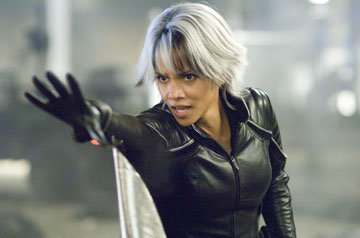
I mean, the wig in the first film was AWFUL, the second wig was a slight improvement, but this one is an affront to humanity (the filmmakers even refer to it directly in an icky moment between Storm and the Beast when Berry squeals, "You've changed your hair!" And the Beast notes, "So have you." Not enough). Anyway, Storm has a larger--a much larger--role in "Final," and it becomes eminently clear why Singer kept her lines down to a minimum in the first two films: the woman can't act. Compare the cut scene on the first X-Men DVD in which Storm teaches a class of mutants. Awful. Every word she utters is a lie, including "a" and "the." No, that implies too much intention--she doesn't know what the fuck she's doing. Okay, Halle. HALLE! Repeat after me: Storm is a what? A what? You don't know? Storm is an African Weather Goddess. She is regal. English is not her first language. I know, honey, I know, don't cry, baby. I know, accents are hard. But you're getting paid. You are a professional actress. Get to work.
Berry is so laughable with almost every syllable she utters. She's made Storm all sassy 'n' shit--watch her tell off Wolverine. You go, girl! Snap! Snap! She does Storm like she's just this side of white from Kim and Cookie. And every time she uses her "weather-witch" powers she goes all slack jawed like she's having a seizure (the whited-out, Little Orphan, Annie Eyes don't help). Ok, remember in the first film when Sabretooth is chocking the goddamn out of her in the train station, and she goes all slack and mouth-breathery in the face, and you think she's dying, then her eyes go all white and she calls down lightening from the heavens? It's like that every time in this movie. Oh, I'll vomit if I go on. Fire her.
Beast
Why hire Kelsey Grammer to do Hank McCoy? I dunno, because no one's looking to hire him to do Shakespeare again any time soon, and maybe he needed the work. But he's okay more or less. It's the atrocious make-up they've saddled him in that hurts the soul so. Okay, he's BLUE. He's fucking blue.... I can't help thinking Singer would not have been so literal. Just see for yourself.

First of all, the Beast is kinda sexy, even covered in fur. But come on people, make him blue-black or something. Whatever.
The Morlocks
Some genius working on this movie thought it would be way cool if the living-in-the-sewers, outcast, underground mutants, known as the Morlocks should all be various ethnic minorities, and dressed like some horrible, post-apocalyptic, fashion mistakes, fresh as hell from the 80s. I mean, honestly, they look like characters visiting from the set of a Pat Benatar music video. It's sorta analogous to the S and M themed costumes for Two-Face's gang in the Val Kilmer Batman Forever fiasco. Remember them? Someone who has no idea what they're doing thinks something they know nothing about looks cool, so that over-determined design makes it into the movie. The image resonates, that's enough; it doesn't really matter what it might mean. Hey! In a mutants-as-queer franchise, let's make the Morlocks all Latin or sorta Asian or sorta androgynous. What a great idea! There's such a misguided, bad-faith race, class vibe about this choice that my skin crawls. Except for Halle (and, let's not kid ourselves too much about her, anyway), all the major players are white white white. Then having Magneto send these "pawns" to their deaths for his cause--which superficially includes them--is simply repugnant. And this from a Holocaust survivor.... Yeah, bigoted Magneto's all about the end-justifies-the-means. This move drains all the nuance out of the character--it's just sad to see McKellen put through his paces this way. It doesn't serve the narrative or the character, it just makes him into the easy villain of the piece. Why make his morally complicated decisions interesting or even intelligible when he can just be a dick?
Phoenix
Okay, this is where the serious geek factor enters the conversation: Yes, I was a big X-Men fan back in the day when the Phoenix/Dark Phoenix saga was first published. X-Men writers since then have hopelessly muddled it--I gave up trying to follow the latest convoluted explanation for Phoenix long ago, having lost all desire to know or care. But when the story first came out, it was clean and relatively simple: Jean Grey, selflessly saving her teammates, perished in a radiation storm while piloting their ship back into the earth's atmosphere. The ship crashed and she emerged with much greater powers, a new costume, and a new name, "Phoenix." In a major, very cool plotline, an old X-Men villain, named Mastermind (he's an illusion-caster, and was re-tooled as Jason Stryker in the second X-Men movie), was able to enter her mind, and essentially alter her personality, making her the Black Queen of the Hellfire Club (don't ask, just know it's as bad as it sounds). Thanks to Scott (Cyclops) she came to her senses, but the damage was done. Mastermind's manipulation had unleashed a power-hungry side of herself that manifested, just as soon as they defeated the Hellfire Club, as the ridiculously powerful Dark Phoenix. She flew off into space, consumed a star (yes, you read that right), which had the unfortunate side-effect of destroying a planet of asparagus people. That's right, asparagus people. Dark Phoenix returned to earth, fought the X-Men, and with Xavier's help, Jean was able to reassert her personality and place "psychic blocks" which would keep her extraordinary, cosmic-level psychic abilities under wraps. All seemed good until a race of aliens arrived to claim justice for the poor dead asparagus people. In a fight with the aliens (on the moon, no less), Jean reverted to Phoenix, and knowing she couldn't control her power indefinitely, telekinetically triggered a space cannon to blast herself into smithereens.
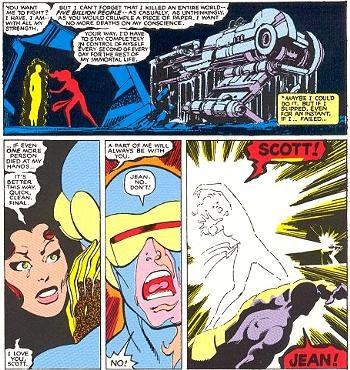
The movie should have been about Jean, the Phoenix, and the X-Men. I'm not an adaptation literalist by any means; in fact, I believe what was so admirable about Singer's two X-Men movies is that they departed from the comic to a significant degree, had their own internal coherence, satisfied fans and newcomers alike, and were sophisticated, well-crafted, superhero action films with a serious ethical undertone. Not easy, people. The Harry Potter movies actually got better as they went probably because J.K. Rowling was around to control quality and because after Chris Columbus left, the franchise finally got good directors on board, ones who have this thing called "vision" and the wherewithal to carry it out. But I digress.
Back to Phoenix in X-Men 3. I enjoyed the references to Carrie and The Exorcist--it's too bad that the cleverness regarding this character was relegated to a series of visual cues, but what can you do? Jean (or Phoenix) "wakes up" from under the lake, kills Scott immediately with a vampire kiss, lapses into a coma long enough to be discovered by Halle and Hugh and brought back to the mansion, wakes up, comes on to Hugh, leaves, kills the professor (in a mostly cool scene, effects-wise), joins Ian McKellen, and spends the rest of the movie standing there in a red dominatrix outfit, looking peevish. That's it! Sure, at the very end, she gets all scary, pretty much for no reason, so Hugh pops his claws into her. The End. This is the Phoenix Saga? This is a story? The original comic version told an epic and tragic tale of ambivalence, madness, loneliness, love, redemption, and finally death. I tell you, you hand Hollywood gold on a silver platter, and they still find a way not to get it. This thing had no-brainer written all over it from the get-go. But last and not least, where was the Phoenix Effect I ordered?? I'll tell you where: superimposed on a lake surface at the end of the last film.
One last thing: I like Famke Janssen--she seems smart, she played a mean transsexual on Nip/Tuck, she speaks four languages, and provides the Dutch-language narration for the Studio Tram Tour at Disney parks. I just wish she's had something to do in her last outing as Jean Grey. Oh. And I wish they hadn't dyed her hair that absurd magenta-orange too.
Rant over.
All that said, X-Men 3 isn't a steaming pile of shit. It's an engaging summer blockbuster, and the special effects with the Golden Gate Bridge are kinda breathtaking. The problem is just that except for having the same actors playing the same characters, it bears almost no relationship to what Bryan Singer did before it. I'm not saying don't see it, I'm saying it is a weak, empty-headed, by-the-numbers follow-up to a couple of movies that managed to achieve something pretty special. (Did you like how I saved anything nice to say till the end?)
Now, one last thing. People always wanna know why so many gay guys like comic books. It's because the artists draw men like this:
X-Men 3: The Final Movie
Or we pray it is the final installment in this stalled series. Where to begin with the list of grievances and missed opportunities? Where to begin....
I should start by saying that I really liked the first two movies. Or I should say I loved the first one, and enjoyed the second. When I learned Singer was leaving the franchise, I did not ask for whom the bell tolled (I could hear it in the distance). The tolling became deafening when I read the auteur responsible for Rush Hour, Rush Hour 2, and Red Dragon was the new man at the helm. After seeing the final product, I was not let down by what I found.
X-Men 3 is NOT saved by Jackman, McKellen, and Stewart--whom, I might point out, are all non-American actresses. They do the best job they can with weak material, but the dialogue is just shit, and each of them says some truly stoooopit, out-of-character stuff. Stewart has to snit at Jackman--after the living hell of explaining the film's version of the Phoenix; McKellen does the best he can with, "WHAT HAVE I DONE?!"; and Jackman comports himself well with his "JEEEEAN!!!!"
Nothing can save the film from the awfully idiotic choice of writing Magneto to go off the callous deep end: his egging Joenix on, his heartless dropping of Mystique after she saved his ass and as a result lost her powers ("DAMN. That shit is COLD," I actually said out loud), his decision to use the mutant "cure" against other mutants, and most egregious his sending the Morlocks to their deaths in the final battle sequence, dismissing them with a gloating smile as "pawns." Nice brotherhood you got going there, Magneto. After the first two films spent so much time presenting Magneto as a textured, complex character, this latest edition pulls no punches and displays him in full fascist--Holy Richard the III, Batman--mode. Too easy. And lame. Did I mention lazy?
Now to pile up the corpses.
Halle Berry
Thank god they got Tina Turner to lend Halle one of her old wigs from the 80s.
"It's okay, Jackie!"
I mean, the wig in the first film was AWFUL, the second wig was a slight improvement, but this one is an affront to humanity (the filmmakers even refer to it directly in an icky moment between Storm and the Beast when Berry squeals, "You've changed your hair!" And the Beast notes, "So have you." Not enough). Anyway, Storm has a larger--a much larger--role in "Final," and it becomes eminently clear why Singer kept her lines down to a minimum in the first two films: the woman can't act. Compare the cut scene on the first X-Men DVD in which Storm teaches a class of mutants. Awful. Every word she utters is a lie, including "a" and "the." No, that implies too much intention--she doesn't know what the fuck she's doing. Okay, Halle. HALLE! Repeat after me: Storm is a what? A what? You don't know? Storm is an African Weather Goddess. She is regal. English is not her first language. I know, honey, I know, don't cry, baby. I know, accents are hard. But you're getting paid. You are a professional actress. Get to work.
Berry is so laughable with almost every syllable she utters. She's made Storm all sassy 'n' shit--watch her tell off Wolverine. You go, girl! Snap! Snap! She does Storm like she's just this side of white from Kim and Cookie. And every time she uses her "weather-witch" powers she goes all slack jawed like she's having a seizure (the whited-out, Little Orphan, Annie Eyes don't help). Ok, remember in the first film when Sabretooth is chocking the goddamn out of her in the train station, and she goes all slack and mouth-breathery in the face, and you think she's dying, then her eyes go all white and she calls down lightening from the heavens? It's like that every time in this movie. Oh, I'll vomit if I go on. Fire her.
Beast
Why hire Kelsey Grammer to do Hank McCoy? I dunno, because no one's looking to hire him to do Shakespeare again any time soon, and maybe he needed the work. But he's okay more or less. It's the atrocious make-up they've saddled him in that hurts the soul so. Okay, he's BLUE. He's fucking blue.... I can't help thinking Singer would not have been so literal. Just see for yourself.
Dr Jekyll or Papa Smurf, I presume.
Now, this is what the Beast is supposed to look like, as rendered back in the day by John Byrne at his prime (inks by Terry Austin).First of all, the Beast is kinda sexy, even covered in fur. But come on people, make him blue-black or something. Whatever.
The Morlocks
Some genius working on this movie thought it would be way cool if the living-in-the-sewers, outcast, underground mutants, known as the Morlocks should all be various ethnic minorities, and dressed like some horrible, post-apocalyptic, fashion mistakes, fresh as hell from the 80s. I mean, honestly, they look like characters visiting from the set of a Pat Benatar music video. It's sorta analogous to the S and M themed costumes for Two-Face's gang in the Val Kilmer Batman Forever fiasco. Remember them? Someone who has no idea what they're doing thinks something they know nothing about looks cool, so that over-determined design makes it into the movie. The image resonates, that's enough; it doesn't really matter what it might mean. Hey! In a mutants-as-queer franchise, let's make the Morlocks all Latin or sorta Asian or sorta androgynous. What a great idea! There's such a misguided, bad-faith race, class vibe about this choice that my skin crawls. Except for Halle (and, let's not kid ourselves too much about her, anyway), all the major players are white white white. Then having Magneto send these "pawns" to their deaths for his cause--which superficially includes them--is simply repugnant. And this from a Holocaust survivor.... Yeah, bigoted Magneto's all about the end-justifies-the-means. This move drains all the nuance out of the character--it's just sad to see McKellen put through his paces this way. It doesn't serve the narrative or the character, it just makes him into the easy villain of the piece. Why make his morally complicated decisions interesting or even intelligible when he can just be a dick?
Phoenix
Okay, this is where the serious geek factor enters the conversation: Yes, I was a big X-Men fan back in the day when the Phoenix/Dark Phoenix saga was first published. X-Men writers since then have hopelessly muddled it--I gave up trying to follow the latest convoluted explanation for Phoenix long ago, having lost all desire to know or care. But when the story first came out, it was clean and relatively simple: Jean Grey, selflessly saving her teammates, perished in a radiation storm while piloting their ship back into the earth's atmosphere. The ship crashed and she emerged with much greater powers, a new costume, and a new name, "Phoenix." In a major, very cool plotline, an old X-Men villain, named Mastermind (he's an illusion-caster, and was re-tooled as Jason Stryker in the second X-Men movie), was able to enter her mind, and essentially alter her personality, making her the Black Queen of the Hellfire Club (don't ask, just know it's as bad as it sounds). Thanks to Scott (Cyclops) she came to her senses, but the damage was done. Mastermind's manipulation had unleashed a power-hungry side of herself that manifested, just as soon as they defeated the Hellfire Club, as the ridiculously powerful Dark Phoenix. She flew off into space, consumed a star (yes, you read that right), which had the unfortunate side-effect of destroying a planet of asparagus people. That's right, asparagus people. Dark Phoenix returned to earth, fought the X-Men, and with Xavier's help, Jean was able to reassert her personality and place "psychic blocks" which would keep her extraordinary, cosmic-level psychic abilities under wraps. All seemed good until a race of aliens arrived to claim justice for the poor dead asparagus people. In a fight with the aliens (on the moon, no less), Jean reverted to Phoenix, and knowing she couldn't control her power indefinitely, telekinetically triggered a space cannon to blast herself into smithereens.
She's dead, Jim.
As you can see, only a small handful of these elements found their way into the screenplay for X-Men 3. What Bryan Singer had in mind when he decided at the last minute to re-shoot the ending of X-Men 2, so that Jean died, complete with a "Phoenix Effect" in the water at the very end, is any one's guess. He had clearly decided to do the Phoenix story in the third film, but who knows what of his intentions actually made it to the screen. In fact, the Phoenix Saga is exactly what we do not get. Instead, Jean-Grey-as-God is a measly subplot in the much less interesting and far less operatic main plot of the mutant "cure" and Magneto's full-scale war against it. The lame and perfunctory Rogue-Iceman-Kitty love triangle got more freakin' screen time.What-we-wanted vs. What-we-got
The movie should have been about Jean, the Phoenix, and the X-Men. I'm not an adaptation literalist by any means; in fact, I believe what was so admirable about Singer's two X-Men movies is that they departed from the comic to a significant degree, had their own internal coherence, satisfied fans and newcomers alike, and were sophisticated, well-crafted, superhero action films with a serious ethical undertone. Not easy, people. The Harry Potter movies actually got better as they went probably because J.K. Rowling was around to control quality and because after Chris Columbus left, the franchise finally got good directors on board, ones who have this thing called "vision" and the wherewithal to carry it out. But I digress.
Back to Phoenix in X-Men 3. I enjoyed the references to Carrie and The Exorcist--it's too bad that the cleverness regarding this character was relegated to a series of visual cues, but what can you do? Jean (or Phoenix) "wakes up" from under the lake, kills Scott immediately with a vampire kiss, lapses into a coma long enough to be discovered by Halle and Hugh and brought back to the mansion, wakes up, comes on to Hugh, leaves, kills the professor (in a mostly cool scene, effects-wise), joins Ian McKellen, and spends the rest of the movie standing there in a red dominatrix outfit, looking peevish. That's it! Sure, at the very end, she gets all scary, pretty much for no reason, so Hugh pops his claws into her. The End. This is the Phoenix Saga? This is a story? The original comic version told an epic and tragic tale of ambivalence, madness, loneliness, love, redemption, and finally death. I tell you, you hand Hollywood gold on a silver platter, and they still find a way not to get it. This thing had no-brainer written all over it from the get-go. But last and not least, where was the Phoenix Effect I ordered?? I'll tell you where: superimposed on a lake surface at the end of the last film.
One last thing: I like Famke Janssen--she seems smart, she played a mean transsexual on Nip/Tuck, she speaks four languages, and provides the Dutch-language narration for the Studio Tram Tour at Disney parks. I just wish she's had something to do in her last outing as Jean Grey. Oh. And I wish they hadn't dyed her hair that absurd magenta-orange too.
Rant over.
All that said, X-Men 3 isn't a steaming pile of shit. It's an engaging summer blockbuster, and the special effects with the Golden Gate Bridge are kinda breathtaking. The problem is just that except for having the same actors playing the same characters, it bears almost no relationship to what Bryan Singer did before it. I'm not saying don't see it, I'm saying it is a weak, empty-headed, by-the-numbers follow-up to a couple of movies that managed to achieve something pretty special. (Did you like how I saved anything nice to say till the end?)
Now, one last thing. People always wanna know why so many gay guys like comic books. It's because the artists draw men like this:
27 April 2006
So I Read Comic Books
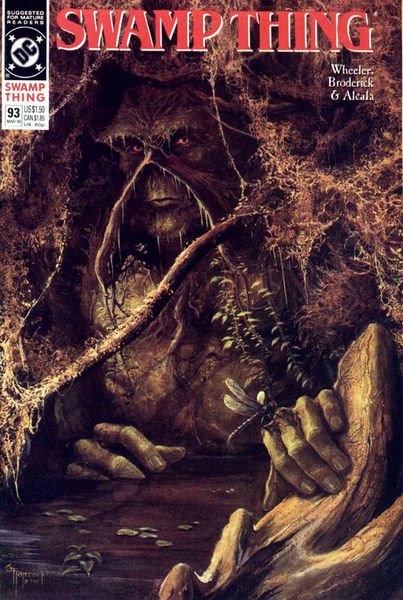
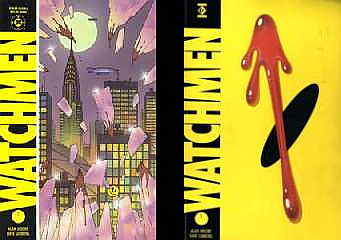
When I was but a wee slip of a thing, the original Superman movie came out (1978). I responded to it on so many levels that I can scarcely describe them all here, but the sheer romance and scope of the narrative: parental fidelity (doubled!), the injunction to do good, the sadomasochistic flirtation with Lois (to be explored in its full, self-denying fruition in the sequel), the helplessness of that first taste of Kryptonite, the humor, the drama, the tenderness of finding Lois dead, the erotic fixation on Chris Reeve, believing a man can fly.... This has been explored elsewhere, but the bottom line is that this began a fixation on comic books that was just this side of addiction. We're talkin' sneaking comics hidden in my tube socks under my jeans into the house, we're talkin' being kicked out of the Wawa in South Jersey for reading comics with the phrase, "this isn't a library," we're talkin' switching from bag lunches to school lunches to grub food off of friends and use the lunch money to buy comics. This lasted from age nine to my college years when, finally, the hold began to wane, but not before Alan Moore upped the ante of comic writing with "The Killing Joke," "Swamp Thing," and "Watchmen."
Nothing was so sweet as coming home with an issue of Moore/Bissette/Totleben/Wood's "Swamp Thing" and a fresh roll of Sprees, to lie on my stomach on my bed, the comic on the floor, and scan, then re-read the damned four-color addicting object. That's what it was like.
I gave up comics in college about the time that Marvel decided to use the X-Men craze to tell stories across multiple titles--some you couldn't give a rat's ass about--to get you to buy even more comics. It was a craven, cynical market move, and it killed my interest.
Sure, from time to time, I would pop into St Mark's Comics or Forbidden Planet to bewilderlngly examine the many titles I couldn't find myself caring about. This all changed last year (plus) when DC started to amp up their Infinite Crisis event with "Identity Crisis" and the "Countdown" (and mind you, I was cajoled into even caring about this by friends who were following it: to wit: DC had hired a dude to oversee production, and he had the idea that they could tell a story on an extremely large canvas, using all the books they were publishing. This ambitious scheme involved 1) creating a stronger continuity among all the books where there wasn't one before, 2) highlighting the "Big Three" of the canon, being Superman, Batman, and Wonder Woman, and drawing a specific series of relationships among them, including Batman's obsession with Wonder Woman and the constant speculation, among the people living in this world, that Superman and Wonder Woman were lovers, and 3) pulling it all towards a Crisis (the twentieth anniversary of the "Crisis on Infinite Earths" [which I read in the original] that did away with the much-beloved [to me] multiverse of Earth-1, Earth-2, Earth-S, etc. [which DC feared was "confusing," but frankly if you don't get the idea of a multiverse or a time-paradox, for that matter, you shouldn't be reading comic books in the first place]), which would shake up the DCU and make for clarifying, and hopefully, exciting new possibilities. The sheer gall of the enterprise captivated me, and I started buying comics again--on a weekly basis--for the first time in almost two decades. Wednesday became Comics Day.
I think the two--the only two--media that have the ability to explore narrative on a very large scale these days are comic books and, yes, TV series. After resisting for five years, and after the many demands of well-regarded, smart friends, I finally got into Buffy, the Vampire Slayer. You have to understand that I don't watch TV, and the title itself was enough to turn me off, but "Buffy" became a major education in surprises. It turned out to be an amazingly well written, very intelligent, exploration of a panoply of themes that got me in a way I wasn't expecting. I don't particularly care if you're a Buffy fan, but Joss Whedon was doing stuff with "Buffy" something that has been hailed on The West Wing, Six Feet Under, Deadwood, Veronica Mars, and The Sopranos as ground-breaking stuff before those shows were even an itch in their Daddy's pants. And on network TV. AND on fuckin' the WB. And all the while, you thought "Reality" TV was the bomb.
Because comics and TV series are basically trash media, no one wants to really give them their due. But the truth is that there is a generation of writers who came up through theory-ridden programs of lit and film, and they are using that education to write some of the best drama available in our culture in, that's right, TV and comic books: the only two media that afford such a large space to explore character, narrative, and storytelling in such a big, operatic fashion. Twenty-two episodes a year is an amazing gift; unending runs of a comic are the same; these people are exploring the uses of their media in a way that no one has done since Laurence Sterne, Woolf, Joyce, or maybe the postmodernist writers of the 1950s. [I don't have the energy to include the non-narrative arts: cubism, architecture, surrealism, etc. Oh wait, maybe I just did.]
Girls, this is exciting stuff.
So, suffering Sappho, that's why I read comics.
I'm not sorry that you don't know what I'm talking about, but I'm glad as hell that I do. There is so much more going on in the world than you think, and it might just be happening in places you don't expect. Open your heart to trash, motherfucker; it just might be smarter than you are.
And, again, that's why I read comics.
A great big shout out to Michael's So I Like Superman and his Uncle Mikey's Funnybook Round-Up and GayProf's Center of Gravitas, which offers a vintage Wonder Woman cover for every post, and most especially this goes out to the unfortunately-titled, but admirable Joe.My.God, who has never, ever, touched a comic to my great sadness.
O Joe. O Joe, My God; O Joe, my fuckin' God, how can I keep praying to you with this knowledge? Oh, my God, Joe. Oh. I am heartened, not that my opinion matters at all, by your enjoyment of this post, which can only be inscrutable to you [My favorite line is: "Random Woman, you stay low. We're moving in."]. Oh, Joe, My God. My God, why have you forsaken me?
Labels:
comics,
dear Kitty
Subscribe to:
Posts (Atom)