Showing posts with label movies. Show all posts

16 April 2015

On Watching "The Walking Dead" II

This image is a metaphor for the show. As such. The dream-like nature of the moment did not prevent me from weeping.

They measure you by what they can take from you. By how they can use you to live.

Meanwhile, back at the end of the world in Georgia, a metaphor is being deployed. And that metaphor is explicating the conflict between, what I would call, Love and right-wing Conservative politics and policies and policing.

On the one hand, we have Our Team that we're rooting for, going through it. Like REALLY going through it. Struggling to find ways to maintain community, friendship, family--and therefore Love--and not turn into the others: not the undead, mindless destroyers, but the living ones, who give up on everything that marks civilization, as such--in a bid, not just to survive, but to dominate--secure in the belief that domination and survival are only coextensive and/or co-Terminus, instead of considering the possibility of them being coterminous.

Rick and Carol's incredibly even, often dead-seeming stare not to the contrary--a stare that, in contrast to most of their actions, only marks the success of their struggle to stay human--our team offers a very textured, layered series of responses regarding one's self-identity and one's self-delusion (often the same thing), one's ability to create meaning, one's love for one's sister or brother, whether one is one's sister's keeper, and whether one is responsible for civilization, or not. I hold that we are responsible for all these things. And I hold to this response-ability, not out of some misplaced nostalgia for a better time in the past, but out of a misplaced interest, desire, and demand for the future. In fact, I require it. I require it of me and I require it of you. 

One's ability to create meaning is core to this metaphor, not as the problem of not creating meaning--a problem we don't have--but out of the necessity and the endless human imperative to do so. We cannot not create meaning. What separates us from the animals and insects--from what we presume to call "Nature"--is meaning-production, in all of its ambiguities, vagaries, and lies. This is the essence of language. 

The issue is not that other animals don't have symbol-systems or feelings--of course, they do--it is just that our symbol-system is shot through with a kind of ambiguity and play that I believe is unknown to our animal friends. Cats are the Japanese of animals; Americans are the dogs; yet, for all the richness of the animal symbol-systems, they pale before ours. It's not their fault. The Axial Age marked a simultaneous and gigantic leap "forward" from them, and we don't know why--no, we don't; not exactly; not really--nor whereto and to what end, though some of the more depressing indicators are clear. 

Certainly, animals have their tools, and their feelings, and their language. Notice their industrial revolution. Marvel at their gridlocked, ideology-consumed, plutocrat-run political systems. Look at their nation-states and their wars, their weapons of mass destruction, their hedge markets and stock exchanges; their banks, pharmaceutical companies; their mustard gas and guns and hydrogen ordnance; their drug addictions and world-wide religious affiliations; look at their laws; look at their writing, their theater and symphonic works and dance vocabulary; their poetry and trash fiction; look at their Jim Crow laws and concentration camps; look at their schools; their utopian claims and their dystopic interventions; look at their lawyers, prostitutes, drug dealers, accountants, lobbyists, and markets; behold their polemics and rhetorics, logics and philosophies; their intense and subtle disagreements about these things; witness their drive for nothing but money; witness their money, their lotteries and casinos, their mafia; their shamans, soothsayers, clergy, and holy men; witness their mystics; and grow to appreciate their full-scale dismissal of climate change, which affects them least of all since they live outside: they have no inside, no insulation, no thermostat, and no aeroplane to take them on vacation; they have no vacation; they have no work, no movies, no television, and no internet. They are fundamentally not like us. So, please, stop boring me with your comparisons to the animals and insects; please stop telling me how much we're alike, because we are not. Your statements are only metaphors as justifications for your behavior--and The Walking Dead is shot through with these comparisons from suitably unsuitable characters--yet I've never seen any "natural" thing do what you do. No; we're stuck with each other, you and I, in this world not created by animals, but modified by animals with an awareness of ambiguity but an unshakable need for certainty, most especially when that certainty is the most deadly thing on the planet. 

The Axial provides evidence for humans employing a new facility for tool-use, including language, which is, after all, also a tool, but hardly only a tool--it is a tool like no other: it is an environment: it is the substance and structure of thought itself: we swim in it and it swims in us. One assumes, in comparison to the animals, that the Axial allowed us to leave the pseudo-psychosis of one-to-one correlations and certainty behind, and embrace the inherent ambiguity of large symbol systems, which are not and never have been set and clear, except to the psychotic among us. I say this is no way to impugn the truly psychotic, who rarely participate in the genocidal-level, sociopathic, blood sport that I will attribute to what I am choosing to call the waking dead. And this is what this post is about.

I began this post saying that The Walking Dead details the various choices of Our Team, the dwindling and growing, waxing and waning, group of survivors clustered around Rick Grimes, who by season five, with his beard, has started to look like a hot cross between Jesus and God. There are other choices being detailed as well, in this employment of metaphor, and these, for the most part, do not involve Love. What we witness instead is the spectacle of humans going feral: humans in the wild, not just without civilization to keep them in check, but a demonstrable rejection of civilization. We are speaking of a different kind of discontent. Rather it is a new kind of contentment with savagery, with murder, cannibalism, and pleasure in these things. It is Schadenfreude articulated at the level of an ethos.

Over and over Our Team either comes across people or is come across by people who have made horrible choices--and Our Team has made HORRIBLE choices, too--but these others, the waking dead, only have it in for anyone else who crosses their path, in an Us Against Them, that must always and only end badly, must always end in Evil. Our Team actively resists this conclusion--and it is a conclusion, in every sense of the term--and we, as audience members, yell at the screen, "Kill them!" but they very rarely do. To us, the paranoia of the Zombie Apocalypse puts us more into the camp of the waking dead than Our Team. Their struggle with this question is the problem and the point.

Despite the blood and gore, which has become more intense, even personal, as the series progresses, despite the first two seasons during which the series explored what to do about the zombies--realizing that the zombies are not the text, are only occasionally the subtext of the show, but are the backdrop--the show is about the living, the living who choose to be dead, and the living who choose to not just not be the dead, but who choose to be the living. And for humans, choosing to be the living means always thinking, remembering to feel, and to build bonds based on Love not Death.

Now, the all or nothing, Us Against Them, every-man-for-himself, how-can-your-life-benefit-mine continuation of the destruction of the world of the others, of the waking dead--the very thing that Our Team exists as a site of resistance against, even with all their mistakes--is right-wing, Conservative politics, policies, and policing as we experience it today. It is the coldest, most frightening, death-loving machine the human race has yet produced. It produces the end of civilization and the end of the world without even seeming to believe in either of those things, which is terrifying. And the dreams which are narratives on our television screens and in our comic books--even more remarkable for having been produced by corporations, the great engines of our destruction and political destitution--offer both a critique and an alternative. Must we get to the place on display in The Walking Dead before can realize alternatives are possible?


03 March 2014

On the Oscars


A special Academy Award. Of merit. Was bestowed upon on ALL the men. And women. Who have worked in film laboratories since movies were invented. Director Christopher Nolan accepted on their behalf.
Are you kidding me? THESE people are the people who make film happen. And the fact that the "Academy"-- which is a nominal insult, literally and nominally, to Plato, at the very least--feels it's acceptable to belatedly recognize, in such an offhand fashion, tonight, the numberless, nameless people who have slaved under the yolk of this nonsense, "since movies were invented," is the bend sinister of all Oscar ceremonies, heretofore. But what do I know? I haven't lived for all time, after all, nor have I lived since movies were invented. Please.

Please give me the sacred monsters of yesteryear--please give me movie stars like Burt Lancaster and Marlene Dietrich and Bette Davis--actors who at least understood that, while these people went unnamed, they were the only reason movie stars had a career. That silence measures more greatly than this current too-little-too-late propaganda treatment with no individuals to name. Not one. Not a one.

Where is your "Schindler's List"? Where are the people you have saved from death and forgetfulness? You don't even have one. As much as that film repels me, in an almost meaningless way Schindler's List at least did remember the "Schindler Jews." Can you imagine such a term? "The Schindler Jews." Child, this is the world we live in.

It's almost--almost, and I distinctly said "almost"--like the half-hearted recognition of war heroes or victims of Shoah that we hear of every day, these days, which is also quite, quite, and very, very much too late. Only the problem is this: those earlier sacrifices weren't done willingly. Yet, in peacetime or war, under National Socialism or Holyrood, the late-term memory of the machine that grinds us into dirt for worms, that only belatedly remembers we existed at all at any point--seventy, fifty, twenty years, ten years later--doesn't redeem any of them in any way, whatsoever. Good luck. Good luck with this "Oscars'" world. I only hope you could ever do better with it than I ever could.

It is indispensably disgusting. And this message of history is what you should take home, in my, very humble, opinion. History never leaves us. You only have to read it. But apparently it never means you won't repeat it.

19 September 2006

Hollywood Commie Love Story: Reds


It says a lot when we see the guy's face but not the lady's 
in a historical romance movie poster....

Turner Classic Movies showed the Warren Beatty motion picture, Reds (1981), last night, so I tuned in to see what all the fuss was about. The movie came well-recommended, and as far as I know, Beatty has the distinction of being the only man, the only person, besides Orson Welles with Citizen Kane, to be Oscar nominated for writer, director, producer, and best actor for the same film (and Beatty had done it before with Heaven Can Wait [1978], so he's the only one to pull it off twice). I like Beatty and I like his movies, though it's funny that after all his acclaim, he still seems to have a weird reputation as a pretty boy. It isn't easy to live down a face like that, I guess.

The image “http://www.movietreasures.com/SigPix/04/013_beatty.jpg” cannot be displayed, because it contains errors.

So, what's Reds about? Well, it concerns two people you've probably never heard of, and a couple others you might have. Beatty plays Jack Reed, a radical, American journalist, labor advocate, and later, Communist to Diane Keaton's Louise Bryant, an early feminist, Marxist, and writer. Heard of them? I didn't think so. The film is first and foremost an epic love story, and in that sense it is hugely successful as Jack and Louise follow each other across the world as they lose, find, lose, and find each other. Much of this is really lovely, though some arrives a bit over-done for my taste. The second major, and overlapping--competing--narrative concerns early 20th century politics, Communism, and the 1917 Russian Revolution, because, you see, Reed and Bryant were in Russia when it was all going down while reporting on the revolution and its major players. After returning to the States, Reed became a delegate from an American Communist organization and died in Moscow in 1920. He is the only American honored by burial at the Kremlin.

The image “http://www.thecolumnists.com/johnson/johnson7art2.jpg” cannot be displayed, because it contains errors.
Our leads. (There's a terrific shot in this scene 
on the train where Keaton looks like Louise Brooks.)

It's great, exciting, epic stuff, and the film covers a lot and is long (194 minutes), but probably needs to be a little longer in order to fill in a few historical and emotional holes. The problems I have with the film have primarily to do with Beatty and Keaton and I'll start with Keaton. She plays Louise Bryant as a dilettante who grows into a committed writer and intellectual--fine. But she comes off as a whiny bore for most of the first half of the film, espousing free-love when she wants to bed Reed's friend, Eugene O'Neill (played by Jack Nicholson in a complex performance), then throwing a ridiculous tantrum when she hears Reed has slept around too. Maybe this is historically accurate, maybe she was directed this way--who can know for certain--but it reduces the Bryant character to an unsophisticated, nagging pain, always annoyed that Reed is off doing political work when he should be with her. The incoherence of the character is only resolved at the end when she makes an arduous, and illegal, journey to Russia to be with her man. I don't mean to suggest that Bryant should have been more likable in the film--more the opposite--I feel her convictions and motivations should be more consistent and convey the vibrant, brainy woman she appears to have been. (Side bar: we get some of our info about Bryant from interviews with Reed's living contemporaries that brilliantly punctuate, and puncture, the film narrative. This device strikes me as the most interesting feature of Reds and serves to position the events in history, even while it unravels the film's portrayals of Reed and Bryant.)

Maureen Stapleton as Emma Goldman

My other gripe about Keaton, is the way her acting conveys the politics of her character in the film. Only Maureen Stapleton really offers a sustained portrayal of political conviction as the anarchist, Emma Goldman--she won an Oscar for it, and she's terrific: sardonic, tough, utterly committed, and fierce. Keaton, on the other hand, gives a long speech at Nicholson where she just rants at him, and when she takes a breath, the whole thing falls apart, as if she were only trying to get through it. As I watched, I thought, is this a speech from someone who believes what she's saying, or a performance of what someone thinks conviction is supposed to look like? Obviously, I believe it's the latter, and especially when you compare it with anything Stapleton does--and almost all her onscreen dialogue is of a radically political nature--because she acts circles around Keaton here. Where Keaton blasts through her lines as quickly as she can, Stapleton modulates, punctuates, and colors, as though what she were saying didn't all signify the same thing, which is how it feels with Keaton. Thus Diane Keaton almost always comes off as politically naive and a crass ideologue, which isn't moving or involving, and makes Bryant's politics seem flat, not passionate. The exception that proves the rule occurs in Bryant's scene before Congress--here, Keaton is restrained, wise, and sarcastic, which suits the character immeasurably.

Love triangle-y

Beatty has a similar problem, and his Jack Reed just seems to repeat himself without displaying any of the charisma we are told that Reed had as a public speaker. I know Beatty had his plate full as producer, director, and star, but the part demands more than the attitude of political conviction--all we really get of Reed is that he was a hard-worker, and all his real passion is relegated to the love relationship with Keaton. Because Reed's radicalism is meant to complicate, and be at some odds with, the love story, the muted nature of Reed's politics and Beatty's performance throws the film off balance. Clearly, this wasn't Beatty's intention as the movie is structured around the back and forth of love and politics, which again only "works" when Bryant throws her lot in with Reed entirely in the final chapter. This sort of politics vs love/work vs domesticity/male vs female matrix could only be written, as far as I'm concerned, by a man. This, for lack of a better word, gender bias accounts to some degree for the way Bryant appears--incomplete, inconsistent, vacillating, and hysterical--for much of the film, and therefore Stapleton's Emma Goldman rises as the spectre of what Bryant should or could have been, which I think is both an intentional contrast in the script, and a kind of return of the repressed in the Bryant character; a repression that occurred in the way she was written.

Stapleton died this year at 80, by the way.

Beatty's acting demands one last note about how he often resorts to a comic reading of a scene, line, or reaction. I'd need to look more closely at his work in other films, but here it comes off as a crutch, a short-hand to make Reed sympathetic, and perhaps as a conscious foil for Beatty's own good looks. I'll only give one example: Reed and Bryant's Moscow flat has a crystal chandelier that hangs a little low for Beatty's Jack Reed (Beatty is 6'2"), and he hits his head on it every time he passes by it, and reacts comically every time as the crystals tinkle distractingly. Twice, this would work, but after that, even the most absent-minded professor would remember to duck or do something, anything, differently. Nuff said.

So is Reds any good? Yes, I think it's a great, wonderful film--though uneven here and there and a movie whose project and execution are at odds with one another. In short, Reds is an important, American film that is absolutely worth seeing. I cannot leave unmentioned the spectacular photography by Vittorio Storaro (a Bertolucci DP who has received well-deserved recognition for his work on films as different as The Conformist, Apocalypse Now, Dick Tracy, and The Last Emperor), which locates simple, intimate rooms; huge, frozen landscapes; moody, crowd scenes; emotionally-relevant, figure/spatial arrangements; and unsparing, facial close-ups on the same screen. His work is the great bond that holds the film together where the script and performances falter. There is much to learn of what not to do as well as what succeeds in this film. Joe Bob says check it out. PS Stephen Sondheim wrote parts of the score.

Of course, I can't help thinking of another Hollywood Commie Love Story, which I'll gripe about another time because it shares so many of the problems that plague Reds. That film, of course, is...

The image “http://www.casagordita.com/images/waywere.jpeg” cannot be displayed, because it contains errors.
Jewish Radical loves Aryan God

But I've said enough for now. Instead I leave you with two seconds of comic relief and Babs, in one of her more unfortunate outfits:

The Norma Desmond look was hot hot hot that year....

27 July 2006

I See Movies Sometimes: The Devil Wears Prada


Hathaway, Streep, and the always-hot Tucci (even when playing an effete fashionista).
Plus check out that FAB plaid suit.


Why add my voice to so many others regarding this trifling film? Two words: Meryl and Streep. She makes a meal out of the Anna Wintour-inspired Miranda Priestly and perhaps invents a way of chewing scenery through understatement. Honest. Directors have finally figured out that she's a terrific comedic actor, and "Devil" gives her plenty of time to show off by not showing off. The scene where she quietly dresses Anne Hathaway down by detailing the fashion history behind the color of Hathaway's shitty bargain basement sweater is worth the price of admission all by itself. And now on to destroy the rest of the film.

The above-mentioned scene is the keystone to why the film ultimately doesn't work because it economically reveals what the film could have been but is not: well-written and featuring a fully-realized protagonist. Anne Hathaway fails utterly to project the necessary intelligence required for this character. That's the acting failure. The above scene also shows the writing failure (which is expected, mind you, since this is a Hollywood movie), because if the Hathaway character were truly as smart as the script tells us ad nauseum, then Streep's explication of the genealogy of the color of Hathaway's sweater would make sense to her and this scene would be her "Ah-ha" moment. It is not. Rather it is the "Ah-ha" moment for the audience as we watch the film dispose of itself so neatly, because if the quality of the writing in this scene, or I should say in Streep's monologue, were indicative of rather than in exception to the rest of the movie, we might have had something really cool. Instead, we get yet another workmanlike retread of a Cinderella story with a half-hearted feminist twist. The subplot involving Hathaway's friends and boyfriend is so pathetic and perfunctory that it's this side of unbelievable, and certainly on the other side of involving in any way. The film seems constantly unsure of what to do next--except when Streep or Stanley Tucci (as Streep's right-hand man cum tart fairy godmother to Hathaway) are on screen--or even of who the Hathaway character is. It does not have a consistent opinion of the value of fashion, the value of Hathaway's experience under Streep, or even the value of Hathaway's independence. This is the kind of shitty "writing" that occurs these days--an enterprise done by committee, product placement, moronic producers, and test audiences. In other words it's less writing than a projection of a hive mind.

Anyway, it's nice to see Streep doing her thing, even if it is often over a cardboard cup emblazoned with a STARBUCKS logo, when such a character would never drink that coffee and certainly would not drink it out of a cardboard cup. And that image represents the coalescence--perhaps the apotheosis, perhaps an obsolescence--of how narrative, character, and art will always experience the wobble introduced by the powerful gravitational field of economics. Quel reprise, Hollywood.

27 June 2006

Superman. The Movie.

Chris Reeve as Superman. What's not to love?
Origin Stories
It's funny. My re-interest in comics is almost neatly coinciding with the revival of the Superman movies (or we hope movies if Singer does a good job), which were the source of my first fascination with comics. As I've mentioned before in this silly online whatsis called a "'blog," Superman, The Movie, and by that I mean the Richard Donner/Christopher Reeve/Margot Kidder/Gene Hackman/Mario Puzo et al. film of 1978, was a fairly powerful factor in my childhood. I am clearly not alone among gay men (and others) in this. Blogs are a-buzzin' with anticipation for Bryan Singer's Superman Returns--opening at the end of the month (and by the time I post this, has already opened)--and most of the excitement I've been reading has been fueled by a strong fondness if not downright love for the first two movies. I am such a painful geek about this stuff that when I saw the first preview for Superman Returns--a loving tribute to the initial cloud, sun, and sky trailer for the first Superman, complete with what sounded like a Brando voiceover, and snippets from the original, John Williams score--I actually got teary. And I'm not so easily moved. But it struck a chord for me, a very old one in an old place that hadn't been touched in a very long time, and that is sort of the reason I'm writing this little tribute to Superman and to some extent Superman II.

Christopher Reeve as Clark KentSecret Identities
There is a quality of sweetness about our childish obsessions, because, and not despite, the fact they were tinged with a green eroticism. There is no doubt whatever that part of the appeal of Superman for me was Chris Reeve, his muscles (especially because he was a skinny, but tall, shrimp of a man before he worked his ass off to get big for the role), his clumsiness and shyness, the sweet holding back he showed with Lois, his manliness, his politeness, his selflessness, and his vulnerability. There is no doubt that as with other hero figures in any boy's life, there was the unintelligible, ineffable difference between wanting to be him and being in love with him. For gay boys, a similar thing happens with the confusion about powerful women: Am I in love with Ann-Margret or do I want to be her?

Curious, isn't it, that gay men seem to be attracted to power of one kind or another: physical, sexual (as we've seen in some cases, but hopefully not often, political power). Yet for me, the appeal of Reeve's Superman was also the vulnerability, the sadness, the withholding, and of course, as has been written on extensively, the double identity. It is a double identity that one yearns to reveal--as Superman yearns to, and eventually does, reveal to Lois--to the people one is attracted to, or to one's parents, or to the world. But the specialness of that secret, its secretness, is always sexualized as the it grows closer to its revelation. It is a tease in the movie--and a self-tease in life, as you struggle to not tell your high school best buddy that you love him, of which it reminds, whether you know it consciously or not--when Clark starts to tell the dazed Lois, just after her interview with Superman, that he is Superman. In these movies, Clark telling Lois his secret is exactly telling her that he loves her. This little piece is what differentiates the Superman films from your garden variety romance films. Can gay men identify with the players in a straight movie romance? Of course they can and do. I do, and this is despite the repugnance I feel at having heterosexuality shoved down my throat by almost every fucking movie that Hollywood produces. Hollywood enshrines a straight love story in nearly every product it puts on the market, whether an action picture, a historical narrative, or, of course, a chick movie. In grad school, studying film theory, I learned this useful bit: it's called "the heterosexual embrace," and this occurs historically at the end of almost any film you can look at, but especially those in the Hollywood mold. Keep an eye out for it. Is the last or the second to last image of the movie an embrace or a kiss between two lovers, two would-be lovers, or two soon-to-be lovers of different sexes? It's as though it were a government directive. It's as though this were so ingrained that moviemakers don't notice they're doing it and movie watchers don't even see it as unusual. The trend is changing slowly, but this still goes on almost all the time. Now, let's ask, do straight audiences identify with either figure in a homosexual embrace in a film? If Brokeback Mountain is any example, the answer is starting to become yes, at least for some straight female members of the audience. As for the heterosexual embrace, neither of the first Superman movies ends with this. It is true that Superman/Clark kisses Lois near the end of both films, the first when she is dead, the second to make her forget his secret and their love affair; and those kisses seal the forbidden nature of their relationship. Whether the times have a-changed enough for gay kids nowadays, or even gay adults, not to feel that same ache is not for me to judge, but the bittersweet denial is what appeals here and, I believe, continues to appeal. To tell the person you love your secret is to tell him you love him, even if you don't tell him the second part. It hides just behind the teeth, this secret, when you are with the one that you love. Gay men and lesbians do not have a lock on this phenomenon, everyone has the experience at some point of wanting to tell the secret of their love to the person they love, with that fear of rejection attached. But for gay folks, queer folks, and bisexual folks there is this layer, this barrier, for much longer than only the most shy or the most different-seeming of the straight fold (I am not insensitive to the fact that heterosexual people can be too "fat" or too "ugly" or too "old"--whatever those sad, mean words are supposed to convey), where revealing one's secret identity and secret love will alter or end forever the relationship one treasures. Superman can take it back with a kiss, we can't.

The image “http://www.theforbidden-zone.com/supermanii/images/s2_518-01_240.jpg” cannot be displayed, because it contains errors.
This isn't the scene, but I love this pic.
What is all this about? Yes, the erotics of wanting to be like someone else are, if not clear, then acknowledged--and the proper term for this in psychoanalysis is, of course, identification. What's left is precisely something to be desired. I think there is an ethics attached to the image we desire and somehow desire to be like. I think it's usually easy to discern the difference between people who wanted to be like Superman and people who wanted to be like, to choose someone related to a very different kind of super-man, Ayn Rand (see Alan Greenspan, see Hillary Clinton) at some point in their formative years. Superman represents kindness, justice, and power that helps those in trouble or danger, and Superman implicitly sets an example. What would the world be like if more people acted like Superman instead of Ayn Rand? Yes, what would Superman do?

Behold: Ayn Rand!
We'll table that and all the other questions of power and responsibility that Rand evokes for a now, because this post is really about Superman as embodied in Superman, the Movie, and that means as Christopher Reeve. It is Reeve's depiction of the Man of Steel that captured my fascination--and while the man and the character have to be somehow separable, you can't have one without the other. It was Reeve as a handsome, sexy, slightly-dorky, truth-telling, puppy-dog, super-powered Boy Scout of Integrity that lit the fire inside; and a nine-year-old could do a lot worse for an example, for an exemplar. What I've realized as I've thought about this over the last few weeks is that there will always be some unconscious part of me, whether I want to or not, that's checks in with Superman, that draws some kind of character from there, because the earliest things we use to build who we are will always be the most powerful. And in this case, as terminally geeky as it sounds, I wouldn't have it any other way.


02 June 2006

I Geek Out Sometimes: X-Men 3: The Final Movie

[I assume you've seen the film. If not, I solemnly swear to take no prisoners and to spare no plot points. This is not a review so much as it's a sort of... "assessment." An annoyed one.]

X-Men 3: The Final Movie

Or we pray it is the final installment in this stalled series. Where to begin with the list of grievances and missed opportunities? Where to begin....

I should start by saying that I really liked the first two movies. Or I should say I loved the first one, and enjoyed the second. When I learned Singer was leaving the franchise, I did not ask for whom the bell tolled (I could hear it in the distance). The tolling became deafening when I read the auteur responsible for Rush Hour, Rush Hour 2, and Red Dragon was the new man at the helm. After seeing the final product, I was not let down by what I found.

X-Men 3 is NOT saved by Jackman, McKellen, and Stewart--whom, I might point out, are all non-American actresses. They do the best job they can with weak material, but the dialogue is just shit, and each of them says some truly stoooopit, out-of-character stuff. Stewart has to snit at Jackman--after the living hell of explaining the film's version of the Phoenix; McKellen does the best he can with, "WHAT HAVE I DONE?!"; and Jackman comports himself well with his "JEEEEAN!!!!"

Nothing can save the film from the awfully idiotic choice of writing Magneto to go off the callous deep end: his egging Joenix on, his heartless dropping of Mystique after she saved his ass and as a result lost her powers ("DAMN. That shit is COLD," I actually said out loud), his decision to use the mutant "cure" against other mutants, and most egregious his sending the Morlocks to their deaths in the final battle sequence, dismissing them with a gloating smile as "pawns." Nice brotherhood you got going there, Magneto. After the first two films spent so much time presenting Magneto as a textured, complex character, this latest edition pulls no punches and displays him in full fascist--Holy Richard the III, Batman--mode. Too easy. And lame. Did I mention lazy?

Now to pile up the corpses.

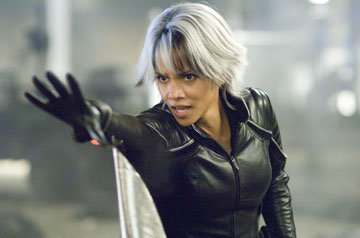
Halle Berry
Thank god they got Tina Turner to lend Halle one of her old wigs from the 80s.

"It's okay, Jackie!"

I mean, the wig in the first film was AWFUL, the second wig was a slight improvement, but this one is an affront to humanity (the filmmakers even refer to it directly in an icky moment between Storm and the Beast when Berry squeals, "You've changed your hair!" And the Beast notes, "So have you." Not enough). Anyway, Storm has a larger--a much larger--role in "Final," and it becomes eminently clear why Singer kept her lines down to a minimum in the first two films: the woman can't act. Compare the cut scene on the first X-Men DVD in which Storm teaches a class of mutants. Awful. Every word she utters is a lie, including "a" and "the." No, that implies too much intention--she doesn't know what the fuck she's doing. Okay, Halle. HALLE! Repeat after me: Storm is a what? A what? You don't know? Storm is an African Weather Goddess. She is regal. English is not her first language. I know, honey, I know, don't cry, baby. I know, accents are hard. But you're getting paid. You are a professional actress. Get to work.

Berry is so laughable with almost every syllable she utters. She's made Storm all sassy 'n' shit--watch her tell off Wolverine. You go, girl! Snap! Snap! She does Storm like she's just this side of white from Kim and Cookie. And every time she uses her "weather-witch" powers she goes all slack jawed like she's having a seizure (the whited-out, Little Orphan, Annie Eyes don't help). Ok, remember in the first film when Sabretooth is chocking the goddamn out of her in the train station, and she goes all slack and mouth-breathery in the face, and you think she's dying, then her eyes go all white and she calls down lightening from the heavens? It's like that every time in this movie. Oh, I'll vomit if I go on. Fire her.

Beast
Why hire Kelsey Grammer to do Hank McCoy? I dunno, because no one's looking to hire him to do Shakespeare again any time soon, and maybe he needed the work. But he's okay more or less. It's the atrocious make-up they've saddled him in that hurts the soul so. Okay, he's BLUE. He's fucking blue.... I can't help thinking Singer would not have been so literal. Just see for yourself.
The image “http://www.evilhippy.net/images/beast.jpg” cannot be displayed, because it contains errors.
Dr Jekyll or Papa Smurf, I presume.

Now, this is what the Beast is supposed to look like, as rendered back in the day by John Byrne at his prime (inks by Terry Austin).

First of all, the Beast is kinda sexy, even covered in fur. But come on people, make him blue-black or something. Whatever.

The Morlocks
Some genius working on this movie thought it would be way cool if the living-in-the-sewers, outcast, underground mutants, known as the Morlocks should all be various ethnic minorities, and dressed like some horrible, post-apocalyptic, fashion mistakes, fresh as hell from the 80s. I mean, honestly, they look like characters visiting from the set of a Pat Benatar music video. It's sorta analogous to the S and M themed costumes for Two-Face's gang in the Val Kilmer Batman Forever fiasco. Remember them? Someone who has no idea what they're doing thinks something they know nothing about looks cool, so that over-determined design makes it into the movie. The image resonates, that's enough; it doesn't really matter what it might mean. Hey! In a mutants-as-queer franchise, let's make the Morlocks all Latin or sorta Asian or sorta androgynous. What a great idea! There's such a misguided, bad-faith race, class vibe about this choice that my skin crawls. Except for Halle (and, let's not kid ourselves too much about her, anyway), all the major players are white white white. Then having Magneto send these "pawns" to their deaths for his cause--which superficially includes them--is simply repugnant. And this from a Holocaust survivor.... Yeah, bigoted Magneto's all about the end-justifies-the-means. This move drains all the nuance out of the character--it's just sad to see McKellen put through his paces this way. It doesn't serve the narrative or the character, it just makes him into the easy villain of the piece. Why make his morally complicated decisions interesting or even intelligible when he can just be a dick?

Phoenix
Okay, this is where the serious geek factor enters the conversation: Yes, I was a big X-Men fan back in the day when the Phoenix/Dark Phoenix saga was first published. X-Men writers since then have hopelessly muddled it--I gave up trying to follow the latest convoluted explanation for Phoenix long ago, having lost all desire to know or care. But when the story first came out, it was clean and relatively simple: Jean Grey, selflessly saving her teammates, perished in a radiation storm while piloting their ship back into the earth's atmosphere. The ship crashed and she emerged with much greater powers, a new costume, and a new name, "Phoenix." In a major, very cool plotline, an old X-Men villain, named Mastermind (he's an illusion-caster, and was re-tooled as Jason Stryker in the second X-Men movie), was able to enter her mind, and essentially alter her personality, making her the Black Queen of the Hellfire Club (don't ask, just know it's as bad as it sounds). Thanks to Scott (Cyclops) she came to her senses, but the damage was done. Mastermind's manipulation had unleashed a power-hungry side of herself that manifested, just as soon as they defeated the Hellfire Club, as the ridiculously powerful Dark Phoenix. She flew off into space, consumed a star (yes, you read that right), which had the unfortunate side-effect of destroying a planet of asparagus people. That's right, asparagus people. Dark Phoenix returned to earth, fought the X-Men, and with Xavier's help, Jean was able to reassert her personality and place "psychic blocks" which would keep her extraordinary, cosmic-level psychic abilities under wraps. All seemed good until a race of aliens arrived to claim justice for the poor dead asparagus people. In a fight with the aliens (on the moon, no less), Jean reverted to Phoenix, and knowing she couldn't control her power indefinitely, telekinetically triggered a space cannon to blast herself into smithereens.

She's dead, Jim.

As you can see, only a small handful of these elements found their way into the screenplay for X-Men 3. What Bryan Singer had in mind when he decided at the last minute to re-shoot the ending of X-Men 2, so that Jean died, complete with a "Phoenix Effect" in the water at the very end, is any one's guess. He had clearly decided to do the Phoenix story in the third film, but who knows what of his intentions actually made it to the screen. In fact, the Phoenix Saga is exactly what we do not get. Instead, Jean-Grey-as-God is a measly subplot in the much less interesting and far less operatic main plot of the mutant "cure" and Magneto's full-scale war against it. The lame and perfunctory Rogue-Iceman-Kitty love triangle got more freakin' screen time.

What-we-wanted vs. What-we-got

The movie should have been about Jean, the Phoenix, and the X-Men. I'm not an adaptation literalist by any means; in fact, I believe what was so admirable about Singer's two X-Men movies is that they departed from the comic to a significant degree, had their own internal coherence, satisfied fans and newcomers alike, and were sophisticated, well-crafted, superhero action films with a serious ethical undertone. Not easy, people. The Harry Potter movies actually got better as they went probably because J.K. Rowling was around to control quality and because after Chris Columbus left, the franchise finally got good directors on board, ones who have this thing called "vision" and the wherewithal to carry it out. But I digress.

Back to Phoenix in X-Men 3. I enjoyed the references to Carrie and The Exorcist--it's too bad that the cleverness regarding this character was relegated to a series of visual cues, but what can you do? Jean (or Phoenix) "wakes up" from under the lake, kills Scott immediately with a vampire kiss, lapses into a coma long enough to be discovered by Halle and Hugh and brought back to the mansion, wakes up, comes on to Hugh, leaves, kills the professor (in a mostly cool scene, effects-wise), joins Ian McKellen, and spends the rest of the movie standing there in a red dominatrix outfit, looking peevish. That's it! Sure, at the very end, she gets all scary, pretty much for no reason, so Hugh pops his claws into her. The End. This is the Phoenix Saga? This is a story? The original comic version told an epic and tragic tale of ambivalence, madness, loneliness, love, redemption, and finally death. I tell you, you hand Hollywood gold on a silver platter, and they still find a way not to get it. This thing had no-brainer written all over it from the get-go. But last and not least, where was the Phoenix Effect I ordered?? I'll tell you where: superimposed on a lake surface at the end of the last film.

One last thing: I like Famke Janssen--she seems smart, she played a mean transsexual on Nip/Tuck, she speaks four languages, and provides the Dutch-language narration for the Studio Tram Tour at Disney parks. I just wish she's had something to do in her last outing as Jean Grey. Oh. And I wish they hadn't dyed her hair that absurd magenta-orange too.

Rant over.

All that said, X-Men 3 isn't a steaming pile of shit. It's an engaging summer blockbuster, and the special effects with the Golden Gate Bridge are kinda breathtaking. The problem is just that except for having the same actors playing the same characters, it bears almost no relationship to what Bryan Singer did before it. I'm not saying don't see it, I'm saying it is a weak, empty-headed, by-the-numbers follow-up to a couple of movies that managed to achieve something pretty special. (Did you like how I saved anything nice to say till the end?)

Now, one last thing. People always wanna know why so many gay guys like comic books. It's because the artists draw men like this:

This is SO eighth-grade jack-off material. Thank you, John Byrne!

24 March 2006

On Bad Films

"Mommy? Where do bad movies come from?"

Well, darling, like bad people, bad movies are made. Now, I happen to love bad movies—many of my friends will attest, and my boyfriend will object, that I will watch anything. As a firm believer in the idea that you can learn how to do things "correctly" by studying things you, and others, admire, not only do I think the converse holds true, but I also say you can even learn how to do cool things by looking at films, or other cultural objects, that went terribly terribly terribly awry. This is really a roundabout way of saying that if you study how things work, and examine their effects, whether it is "good" or not, doesn't necessarily matter.

Let's go back to "bad." Rather than accept that that this one word accurately describes a whole host of films, I submit the uncontroversial hypothesis that there are many kinds of bad films. A whole spectrum, in fact. We round up the usual suspects: "Plan 9 from Outer Space," say, or "Ishtar," or "Valley of the Dolls," or "Beyond the Valley of the Dolls," or, what is to me the most reprehensible in this list, "You've Got Mail." The list is as long as you might like to make it, and will be different for everyone, as I have no doubt that there a number of admirers of the late Ephron oeuvre reading this. I'm not really interested in splitting hairs over personal taste; my point is that there's a common sense notion of film badness out there, and most of us share opinions—many of them received, sure—about which films are supposed to be bad.

An Ironic Excusion
Here's where we get into a glitch. At this historical point in American mainstream culture, there is a powerful factor that muddles what have traditionally been, I think, clearer cut notions of quality and the ways we engage with the "bad," and we call that factor irony. We live in a world where taking an ironic stance about something—anything, everything?—is a pop cultural article of faith. Irony used to be the tool of the educated and urbane, and therefore, often, of the upper classes and of urban places. Ducking into a brief history of Irony, we learn it is a figure of classical Rhetoric derived from the Greek word, eironeia, which means "affectation of ignorance" (NOTE: I ripped off the following examples from the link, they are not mine, but I did study this stuff in school. Honest). Following this cunningly simple source, we are given a definition: "Speaking in such a way as to imply the contrary of what one says, often for the purpose of derision, mockery, or jest." This sounds closer to what we're used to hearing when Irony is in the room. Yet, if we dig a little deeper, because this is Rhetoric, a more nuanced taxonomy has been derived down, and that means, Figures of Rhetoric, such as Irony, have related Figures depending from them, the Figures for Irony are:

antiphrasis: From the Gk. "to express by antithesis or negation." Defined: "Irony of one word, often derisively through patent contradiction; e.g. Referring to a tall person: "Now there's a midget for you."

paralipsis: From the Gk, "to leave to one side." Defined: "Stating and drawing attention to something in the very act of pretending to pass it over"; e.g. "It would be unseemly for me to dwell on Senator Kennedy's drinking problem, and too many have already sensationalized his womanizing...."

epitrope: From the Gk, "to yield." Defined: "A figure in which one turns things over to one's hearers, either ironically, or in such a way as to suggest a proof of something without having to state it. Epitrope often takes the form of granting permission (hence its Latin name, permissio), submitting something for consideration, or simply referring to the abilities of the audience to supply the meaning that the speaker passes over. Epitrope can be either biting in its irony, or flattering in its deference"; e.g. "Because all things [be] taken away, only is left unto me my body and mind. These things, which only are left unto me of many, I grant then to you and to your power. —R. Sherry." Clearly, this example of epitrope is one where the permission isn't given with much of a choice.

sarcasmus: From the Gk, "to tear flesh, to speak bitterly." Defined: "Use of mockery or verbal taunts"; e.g. like when those impolite Romans said to Christ on the cross: "If you be the son of God, descend from the cross —Matt. 27."

mycterismus: From the Gk, "to sneer." Defined: "It is a mock given with an accompanying gesture, such as a scornful countenance"; e.g. as in telling a misbehaving guest as they leave, "We're SO GLAD you came," with a kind of sneery-smile.

What all of these figures share is the element of negation; each case makes a surface statement that is undermined, mediated, or called into question by the way it's phrased, by a gesture, or the inclusion of an out-of-place contradictory word that can be frivolously ridiculous (tall person as a midget), or contain a derisive meaning as well, relating maybe to his failed performance in business or sex.

But for irony to become a good commodity in common discourse, all those Rhetorical Figures are forgotten, and a streamlined model of irony comes off the assembly line, and that line is the mass media. We can imagine Oscar Wilde as being the godfather of this irony as he played intricate games that seemed frivolous but did so with a high degree of seriousness. But it wasn't until mass media became televisual that this irony—which is a kind of "having on," a dubiousness, a mock, and a maintaining of two frames of mind or reference—was truly produced for and became a part of the masses. The Prometheus that delivered this fire to mortals was our very own Andy Warhol, through his low-art-as-high-art aesthetic (among other things). But more than that, he presented his whole persona and project—stuff that, like Wilde, he took greatly seriously—as silly, meaningless, and empty. The joke was on the viewer or the culture if one decided to believe his shenanigans. It also allowed him to get away with a great deal: were his silk screens clever comments on our culture of reproduction? did they play on the sense that people are things? that ugly photographs of car crashes can be screened with colors to make them go with the couch? or was his art only empty but hip "pop"? Warhol doesn't need to have invented The New Irony, but he certainly practiced it very well, and a lot of people noticed this (I think, by the way, that Warhol was very sophisticated in the ways he employed his ironic stance: the quality of the thing when it's introduced is always different from what it becomes to be more easily disseminated). Furthermore, his Factory produced films and rock groups, which played this irony out into larger audiences outside the art world. "Walk on the Wild Side" is a perfect example of droll ironic shrugging about drag queens, street people, and urban ennui with a great pop hook. We can include the punk aesthetic in this mini-history, but the next big shift happened with MTV and its wild popularity. Suddenly, a New York style of sarcastic hipness was everywhere, and after that you eventually have "Seinfeld" and "Friends." I'm skipping many many steps, but the upshot is that this irony is a much more powerful—and less risky—stance to have toward the world than sincerity (not that I'm holding up sincerity as a better option), and it's deeply embedded in the culture now. Everywhere you look, and I mean primarily in popular culture, there is a smart-ass quip or phrase announcing itself as the next bon mot. I submit Maxim magazine: reading it you get the impression that the editors are making fun of even the things they like. Does this mean that we're all more sophisticated now than our forebears? Yes, I think, yes and no. In the same way more people are literate now than ever before, our use of irony and that double-mindedness which it denotes is more sophisticated; but on the other hand, we're not exactly Oscar Wilde, either.

Back to Bad Movies
I told you that story to tell you this one: so now, taking on the question of a "bad" movie has become rather moot, because everyone likes bad movies now. There is certainly a generational barrier that keep some people over 50 or 60 out of the loop, and you have another cultural resistance in smaller towns, or "Red" states, with people who don't watch TV, go to the movies often, or read lad mags. And then, the best thing is that Hollywood hasn't entirely gotten on board with the new irony, because it is blinded in its pursuit of the test-marketed blockbuster: the film that will appeal to as many people as possible. Yes, we see the release of other, smaller kinds of movies that have no intention of making $100 million the opening weekend, but by and large Hollywood hasn't fully realized that its big money making scheme isn't working (or very cost-effective). Instead, they hire people like Quentin Tarantino, Joss Whedon, and Carrie Fisher to add some zippy dialogue, but it's just another checkbox on the Blockbuster checklist, and while their aesthetical-financial obsession should give us hope for "bad" movies we can enjoy ironically, the results tend to be pretty bland.

Back in the Golden Age before mass-produced irony, no one even knew about "Plan 9 from Outer Space" unless he caught it on "The Late Late Show" or "Creature Double Feature." And the ones who didn't find it incoherent and boring decided it was funny, which is what Tim Burton did. And so a few "bad" movies, by way of a specialized audience were reinvented as "cult" films, a term that has the odor of weird fringiness about it, and that odor is the scent of marijuana. It was the dropouts, freaks, stoners, and funny bachelor men who were members of the various cults surrounding certain films, because who else had time to stay up for the late show or watch "Doctor Tongue's 3-D House of Stewardesses" on weekday or Saturday afternoons when Mr and Mrs America were at work or ironing? College students were the next wave, and why not? It's just another feature of rebelling against your parents by deciding the movies Mom and Dad think are bad, are actually trippy, interesting, or just plain funny.

I Didn’t Mean Anything by It
This is where I come in (did you really think this wasn’t about me at some point?). I am not a fan of The New Irony—I mean, sure it can be fun and all, but often it comes off as a reflex reaction of smug knowingness, a joyless exercise. I had a professor in grad school who wrote in one of his books that “the skeptic annihilates the world” (an always haunting phrase) and, in my opinion, The New Irony contains an irreducible kernel of skepticism. It isn’t a gesture of solidarity with an audience, or it doesn’t need to be. As opposed to a lie, which depends on the ignorance of the audience or listener, Rhetorical irony only functions when the listener also has knowledge; with The New Irony, no audience is necessarily even necessary. Just you. With Rhetorical irony, there is a space or a gap between what is said and what is meant, but there is an intention behind it, and a meaning, that despite its ambiguity is still meaningful; the New Irony believes in nothing, and therefore is about playing a game without a goal. So, the fact that bad movies and bad TV and bad fashion are valued for their hipness is a reliable index, not of nothing exactly, but of nothingness. It is an empty play of signs, signals, and signifiers, wherein the action of arrangement is the art, but to no discernable intentional effect, except, let us say, to be noticed, to register. It is as though an impatience with meaning itself (or even a radically antisentimental stance towards meaning) has supported this shift, this play that somehow has no rules, and no seriousness at all; therefore The New Irony becomes almost pure gesture or style. I know this paragraph is riddled with judgments, and while I engage in The New Irony myself sometimes, just like you, what I’m trying to state here is a preference. I’m old fashioned, and I don’t mind it.

Sometimes You Have to Be Bad
I still like to think of cult movies, mistakes, and trash as "bad." To name something as bad is to locate it someplace, perhaps not a precice location, but one nonetheless, whereas to relate to a film by way of The New Irony is to locate it no place, exactly. Rather than view a bad film by way of an I-know-better ironic agenda, I try to take it for what the "film" seems to be trying to do—and let me say that can get you into some pretty strange neighborhoods. Somebody set out to make these things, and that's more interesting to me than “enjoyment” served up with a condescending ironic twist—I guess what I mean is, you have to take these films seriously on some level. Besides, anything that disappoints, offends, baffles, or bores mainstream tastes is something I want to see. And a lot of these films are bad because they were made by freaks with no budget and a bad handle on production; others are just trashy B—or even C movies—where the plot is only a pretext for getting as many big breasted women with guns on screen as possible. But the holiest of bad films are the ones that were made with a budget, a certain amount (sometimes a lot) of expertise, a recognized if not respectable cast, a lot of pre-release publicity, and the utmost desire to make a really great movie. But either because of the material and the way it was handled, or just some crazy cinematic curse, each person from the director to the screenwriter to the star to the grip and the best boy made the wrong choice at every step of the way, and this created an impossible crystalline-like structure that a creative team could never hope to accomplish on purpose. It just happens. And all the audience can do is gape in disbelief at the embarrassment of otherworldly riches on display. The three timeless examples of this sort of movie magic are, of course, "Valley of the Dolls," "Mommie Dearest," and "Showgirls." If you've never seen them, or you aren't in the ten-plus club yet, you'd better get your freak on and take care of it, because some things really do make living better.

Why am I not writing for the New Yorker?